
Blue Plaque for Buxton born England ‘footballing icon’ Frank Soo
A national blue plaque for the first footballer of East Asian descent to play for England, has been unveiled at his birthplace in Buxton.
Frank Soo, born in 1914 and who died in 1991, has been described as one of the most talented and influential footballers of his generation.
The plaque has been installed at 11 Lightwood Road, Buxton, where Frank was born and where his family ran a laundry business.
Friends of Buxton Station who feature Frank in their tour-of-the-town leaflet and FoBS Chairman, Dave Carlisle said: “Local historian, Julian Cohen, wrote a 2023 book called, ‘Surely not in Buxton’, that showed how Frank’s great achievements had been largely ignored. This inspired us to take up Frank’s case.”
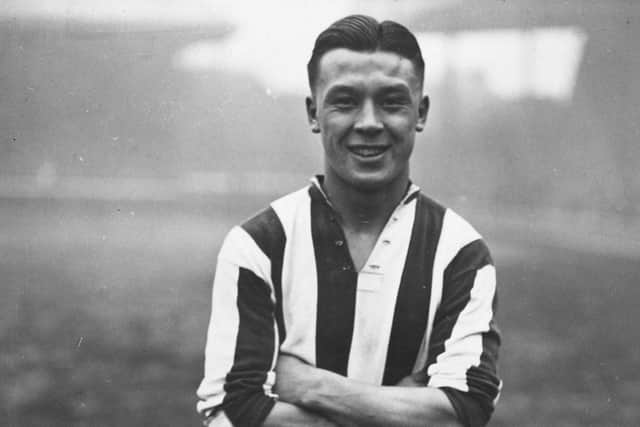

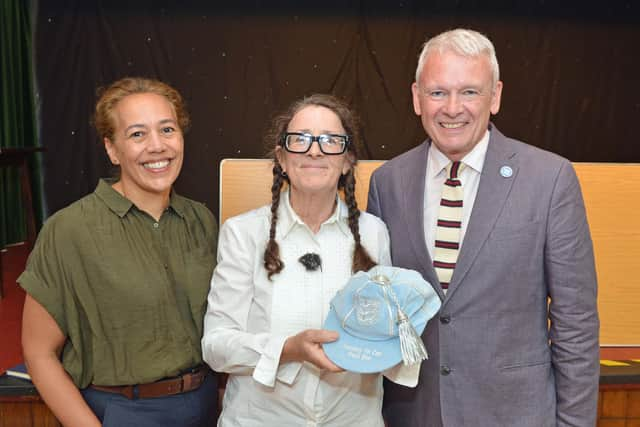
“Frank Soo was never given an England cap, despite playing nine times for our country during the Second World War.
“We felt that this was an injustice, so we pestered the FA, peppering them with complaints until they relented.
“We also wanted his unique footballing legacy to be recognised here in his home town.
“Blue plaques are not given out easily, so we had to work very hard to convince Historic England how deserving Frank’s case was.
“We are thrilled that Frank has finally been properly and truly recognised.”
Julian Cohen said: “I am a football fan and I had lived in Buxton for over 20 years before I discovered that an England footballer had been born a few hundred yards from where I lived. “I am so heartened that, at last, Frank Soo is getting the credit he deserved.”
Claudia Kenyatta and Emma Squire, co-CEOs of Historic England, said: “It feels very appropriate, during a World Cup year, to recognise and celebrate the talent and achievements of Frank Soo.
“He worked incredibly hard throughout his career, playing for England nine times during the war and making his mark at several clubs including Stoke City.
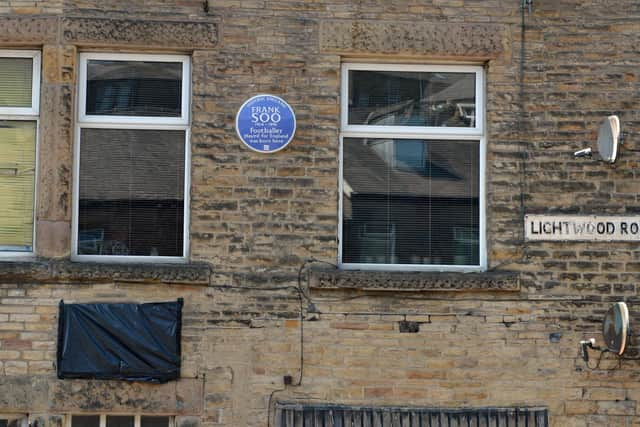
“Through the National Blue Plaque Scheme, we’re proud to commemorate Frank as a footballing icon whose talent broke barriers and whose legacy continues to inspire new generations.”
Frank grew up in a working-class family of Chinese heritage at a time when opportunities for minority communities in Britain were limited and racism was widespread.
He developed into an exceptional footballer, playing for local teams before being signed by Stoke City in the early 1930s.
At Stoke City, Frank became a central figure during the club’s rise in the First Division, eventually captaining the team and making more than 170 appearances.

He was widely admired by supporters and football commentators alike.
His performances led to calls for him to represent England at the highest level.
John Ruggiero, former player for Stoke City, said: "As a former player, and since 2009 a member of Stoke City Old Boys Association, I've had the privilege of being associated with many Stoke City legends.
“Frank Soo is definitely one of our greatest players and he was a trailblazer in his day in terms of what he achieved.
“He fought for his country and also played for his country, something his family must be so proud of.
“Having a national blue plaque awarded to one of our own is fantastic.”
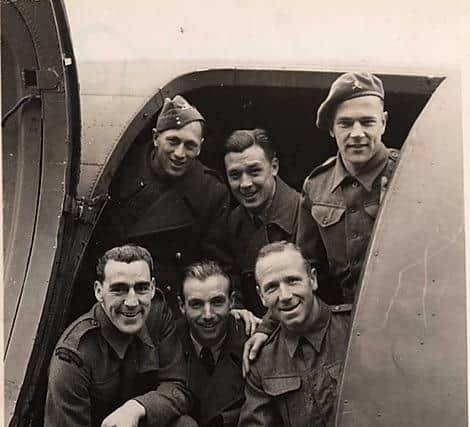
During the Second World War, Frank served in the Royal Air Force while continuing to play football.
Between 1942 and 1945, he played nine times for England, however these fixtures were later classed as unofficial due to wartime and immediate postwar conditions and did not earn him caps.
Nonetheless, Soo is still recognised as the first player of East Asian descent to play for England’s men’s national side.
After the war, Soo continued his playing career at clubs including Leicester City, Luton Town and Chelmsford City.
In the 1950s, he worked in Italy and Scandinavia, becoming the first manager of East Asian heritage in European football.
Frank returned periodically to England before retiring to the North West.
Despite his achievements, Frank Soo’s story was largely overlooked for decades.
Martin Polley, Sports Historian and National Blue Plaques Panel Member, said: “Our aim in honouring Frank Soo with this Blue Plaque is to help put that right.
“He was an elegant, intelligent, and entertaining player, but there was more to him than this. “He was a vocal advocate of footballers’ employment rights at a time when clubs had total control over their players’ lives; he was a pioneer of the sport’s transnational networks in a coaching career that took him to Italy, Sweden, Finland and Norway; and, as the son of a Chinese migrant, he was the first footballer of east Asian heritage to play professionally in the Football League, and the first – and still, in 2026, only – player of that ethnic background to play for England.
“As a pioneer in so many areas, Historic England is proud to commemorate Frank Soo with this plaque.”
In recent years, renewed research and public recognition have helped restore his place in football history.
He has been inducted into the National Football Museum Hall of Fame, celebrated by Stoke City, and just last year (October 2025), the FA presented Soo’s family with a posthumous cap to mark his achievements.
The national blue plaque at 11 Lightwood Road recognises both Frank’s sporting achievements and the wider social history his life represents.
As his birthplace and the site of his family’s laundry business, the building provides a visible link between his working‑class upbringing, the experiences of Chinese communities living in Britain, and his extraordinary rise to the highest levels of the game.
Heritage Minister, Baroness Twycross, added: “He is a vital part of our national sporting heritage, and it is long overdue that his story enjoys this recognition.
“His service to the country on both the pitch and in the Royal Air Force during the Second World War speaks volumes about his commitment to our nation. He deserves his place in our national story, and the community in Buxton can be rightfully proud of this blue plaque.”