
Derbyshire council opposes plans for carbon capture pipeline through Peak District over safety fears
Derbyshire County Council has voted by a majority to oppose massive plans for an underground carbon capture pipeline scheme to run through the Peak District due to safety concerns for residents, farmers and landowners.
Peak Cluster, which is a collaboration between cement and lime producers in Derbyshire and Staffordshire, has outlined plans for the £59.6m project to build a 121 mile underground pipeline to carry captured carbon dioxide from four cement and lime producers across sites in Derbyshire and Staffordshire out to the Irish Sea where it will be permanently stored.
But following growing concerns from residents, Independent County Cllr Ruth George, who oversees Whaley Bridge and Chapel-en-le-Frith, submitted a motion at a council meeting on March 25 for the Reform UK-controlled authority to oppose the scheme on safety grounds which it has agreed to do.
Cllr George told the meeting: “It’s not an anti-cement and quarrying industry motion by any means. I have always been a supporter of the quarrying and cement industries which are so important in High Peak.”

She added: “This motion won’t damage the current cement industry that we have in High Peak and the rest of Derbyshire and it’s also not a motion that denies climate change or the importance of reducing our carbon emissions, but it does say that those reductions must not be at the unreasonable expense to the UK or put whole communities at risk as this project does. My motion is brought primarily on the grounds of safety.”
Peak Cluster has stated the project aims to capture carbon dioxide from four cement and lime producers across sites in Derbyshire and Staffordshire to help to secure the future of Britain’s cement and lime industries while safeguarding and creating jobs and ensuring a reliable, ‘homemade’ supply of essential materials.
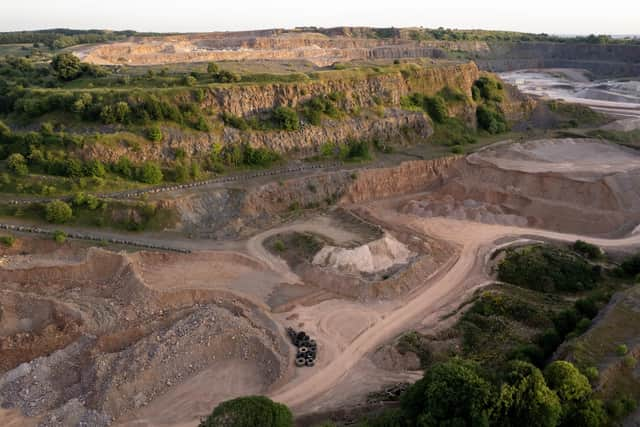
Proposed work plants in the scheme include Buxton Lime’s Tunstead lime plant, at Tunstead Quarry, off Waterswallows Rd, in Buxton, Breedon’s Hope cement plant, at Pindale Road, in the Hope Valley, Tarmac’s Tunstead cement plant, at Waterswallows Road, Tunstead House, in Buxton, and Holcim’s Cauldon plant between Cauldon and Waterhouses villages in Staffordshire.
If approved, the plans will see carbon dioxide transported and stored permanently beneath the East Irish Sea which Peak Cluster claims will help to secure the future of Britain’s cement and lime industries while safeguarding and creating jobs and ensuring a reliable, ‘homemade’ supply of essential materials.

But Cllr George said that carbon dioxide is an asphyxiant – or a gas that can cause death – and the proposed Peak Cluster pipeline aims to run across hills, valleys and land that she claims is unstable with shale and a history of landslides.
She highlighted a CO2 pipeline rupture in Mississippi in 2020 which she says was caused by soil movement after heavy rain which resulted in people collapsing and needing hospital treatment and being left with long-term health problems.
The Independent councillor also said Peak Cluster claims its plans will protect 2,000 jobs but she claims the scheme will double the price of cement after spending millions of pounds on a project that she argues is not safe and endangers Derbyshire communities.
Cllr George stated in her motion: “Low-lying communities such as parts of Whaley Bridge and Peak Forest and busy places such as Chapel-en-le-Frith High School and Tesco superstore in Whaley Bridge are directly below the route of the proposed pipeline. Any rupture could fill these areas with CO2 which is deadly at a concentration of 4per cent or higher.”
She argued the proposed pipeline route targets greenfield sites and it will have a significant impact on nature, breaking up wildlife corridors, uprooting trees and hedges along the route and disrupting protected species such as badgers.
Cllr George says farmers will be forced to allow the 30 to 40metre wide pipeline route across their land disrupting field rotations, land access and drainage and she fears the project will bring at least six years of construction noise and traffic gridlock to communities.
She argued that rather than spending many billions of taxpayers’ money on a 121-mile ‘exhaust pipe’, Government investment should be directed towards more practical environmental initiatives.
Reform UK Cllr Melandra Smith, who represents Buxton North and East, said she does not feel the project is necessary for the future of the minerals industry and she believes it will create years of disruption and she feels it poses a ‘genuine risk to animal and human life’.
Green Party Cllr Lian Pizzey pointed out that carbon capture schemes can be very expensive requiring significant amounts of public money which he feels could be better prioritised.
Labour Cllr Anne Clarke acknowledged there is a need to balance community concerns and the future of the cement and lime industry and job security while suggesting that other technology should perhaps be ‘scaled up’ to address concerns over carbon emissions.
Liberal Democrat Cllr Tom Snowdon said any investment in carbon capture, which he claims is not a ‘mature technology’, is a risk and he would like to see proof the pipeline is going to be safe and he would prefer new technology be introduced so there would be no need to take away massive amounts of carbon.
However, Conservative Cllr Linda Grooby, who represents Buxton South and West, opposed the motion saying cement production contributes nearly a billion pounds to the UK economy and after imports have worryingly tripled in the last decade she argued the scheme would ensure a continued manufacture of local cement and lime while safeguarding 1,400 jobs.
She argued the scheme will also reduce CO2 emissions by 95per cent and that the ‘cost to Government would be paid back in spades’.
Cllr Grooby said that gas and liquids have been transported in the UK for over 100 years and the scheme, which will be governed by much higher UK safety standards, will have to meet engineering regulations and will involve a 30inch thick pipe.
She added: “This carbon capture is the right thing to do for the local economy and for the UK. Numerous changes have already been made to reduce carbon emissions in the industry.
“We now have a choice in the UK relating to CO2 – deindustrialisation or decarbonisation. I know which one I choose.”
Conservative Cllr Wayne Major, who also opposed the motion, said the mineral industry is by far the most important industry to Derbyshire.
He added: “It employs thousands of individuals and it supports the wider UK economy and we have always as an authority backed the goose that lays the golden egg in Derbyshire which is our mineral industry and I am a bit fearful we are going to be walking away from that. The industry may see this as us turning our back on them.”
Reform UK Cllr Carol Wood, Cabinet Member for Net Zero and Environment, revealed that the council is seeking to set up a working group with High Peak Borough Council and the Peak District National Park to address any concerns.
And Reform UK Council Leader, Cllr Alan Graves, said: “This council supports meaningful environmental action, but what we have before us in the Peak Cluster proposal is not that.
“It’s a project that asks our residents, our farmers, our countryside to bear enormous cost and risk for benefits that are distant, uncertain and achieved by far less damaging alternatives.
“This is a 121 mile industrial pipeline cutting through the heart of Derbyshire. Through farmland, through communities, and through some of our environmentally sensitive landscapes, and we are being asked to accept it before the full safety framework is even in place.”
Peak Cluster says the scheme will use carbon capture technology to lock away carbon dioxide emitted at Holcim’s Cauldon plant, Tarmac’s Tunstead cement plant, Buxton Lime’s Tunstead lime plant and Breedon’s Hope plant which will help secure the future for 40per cent of the nation’s cement and lime industries.
Spirit Energy’s Morecambe Net Zero project, which plans to transform gas fields in the Irish Sea into carbon dioxide storage sites, and Peak Cluster are expected to work together to jointly safeguard and create 13,000 jobs by 2050, according to Peak Cluster, with around 1,500 jobs created across the East Midlands and North West during construction.
Peak Cluster has also explained that cement production is responsible for 7.5per cent of global CO2 emissions but it claims its plans will prevent over three million tonnes of CO2 from entering the atmosphere each year while strengthening the industry’s resilience and opening up new opportunities for growth.
It has recognised the production of cement and lime generates CO2 which it says is the single largest contributor to climate change and with 40per cent of all British cement produced in Staffordshire and Derbyshire it says the industry accounts for as much as 23per cent of the counties’ CO2 emissions.
According to Planning Inspectorate documents, the proposed pipeline corridor is to be 300 metres wide and 121 miles long, but this would eventually be narrowed down to 100 metres in width to allow for adjustments while the actual pipes would be around a metre wide.
The council formally recorded its opposition to the proposed carbon capture pipeline while agreeing to support the county’s quarries and cement industry to secure significant Government funding to reduce emissions at source.
Peak Cluster Chairperson David Parkin has said gas and liquids have been transported using pipelines for over 100 years in the UK and the practice is robustly regulated and the UK has a global reputation for safety in this field.
Pipeline design, maintenance and monitoring will also follow regulated safety measures, according to Mr Parkin, including pipelines with heavy walls in areas of high population and surveys will be undertaken regularly and leak detection technology is being explored.
Other Derbyshire local authorities expected to have an interest include Derbyshire Dales District Council, High Peak Borough Council, the Peak District National Park Authority and the East Midlands Combined County Authority.
The Peak District National Park Authority has said it aims to continue to be actively involved in the process hoping to balance the benefits of carbon capture against any potential impact to the national park.
Due to the scale of the project, which is expected to take three years to build across four counties, the scheme is to be decided nationally, with councils merely acting as consultees alongside residents, interest groups and businesses.
Once the proposals are finalised, Peak Cluster aims to submit a Development Consent Order application in 2027 for Government approval.
The construction of the Tarmac Tunstead Carbon Capture Storage facility is expected to begin in 2029 and it is anticipated to take 28 months to build, according to Peak Cluster.
The Government has agreed to award £28.6m towards the estimated £59.6m project with the remaining funding for the scheme to come from private firms, according to Planning Inspectorate documents.
Section 1 of the scheme includes the Breedon Hope Cement Works with a newly-built capture facility and a pipeline carrying captured CO2 to the North Feeder AGI to the south of Chapel-en-le-Frith.
Section 2, of nine pipeline sections, would feature a Tarmac Tunstead Cement Works capture facility, and a Buxton Lime capture facility, located at Tarmac’s Tunstead site, to the north east of Buxton, in Derbyshire with a pipeline to the Chapel-en-le-Frith North Feeder Above Ground Installation, leading to Whaley Bridge and beyond.
Section 3 includes a pipeline which runs from the Chapel-en-le-Frith North Feeder AGI to a Central Feeder AGI, south west of Macclesfield.
Section 4 of the scheme includes the Holcim Cauldon capture facility, in Staffordshire, and a pipeline which passes north of Leek and Congleton before reaching the Macclesfield Central Feeder AGI.
Section 5 will run from the Central Feeder Macclesfield AGI to an AGI in Holmes Chapel, to Section 6 from Cranage to Tarporley, with Section 7 from Tarporley to Picton, and Section 8 from Picton to Ellesmere Port.
Section 9 will run from Willaston to The Wirral before Section 10’s offshore pipeline runs from Leasowe on the north coast of the Wirral.