
Railway station features in latest Buxton Spa Murder Mystery
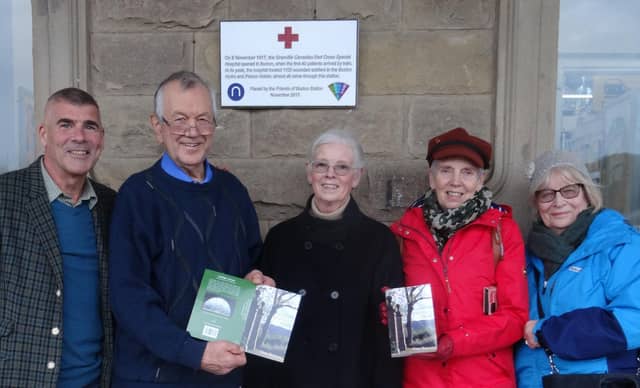

A chance conversation between a local author and the Chairman of a community voluntary group sparked an idea for a wartime story.
Buxton author, Celia Harwood was fascinated to learn details discovered by Dave Carlisle, Chairman of Friends of Buxton Station when he researched a leaflet about the Granville Canadian Special Hospital as part of centenary commemorations.
Dave said: “We met at a literary event and got chatting about the Granville Hospital. I’d unearthed some diaries written by recovering Soldiers and found the day-to-day jottings compelling. They told of hopes and dreams, looking forward as we all like to do.Celia took these themes one step further in “Empire’s Peak,” the eighth Buxton Spa Murder Mystery.”
Dave added: “It’s wonderful that our station features prominently in this work of fiction, I’ve started reading it and think this latest book would make a perfect Christmas present! It is a great way to support a local author and local businesses too.”
Another local author and playwright, Les Oldfield wrote his play “A Crimson Maple Leaf” for the 2024 Buxton Fringe, it explored a similar theme of love, war and loss and was based upon Canadian Soldiers billeted in Buxton.
In June 2025, local author, Alan Roberts published “Maple Leaves,” a book written by his son, David Roberts, which also records Buxton’s role as a base for the Canadian Military Hospital.
Celia said: “Here’s the introduction to Empire’s Peak: the eighth Buxton Spa Mystery: In November 1924, a former officer of the Canadian Army Medical Corps, now a surgeon, returns on the train to Buxton Spa with fond memories of the town where he spent the last years of WW1 at the Granville Special Hospital on Terrace Road treating wounded Canadian soldiers. He has returned after six years’ absence to attend a wedding but finds a very different welcome from the one he expected.”
Adding: “Empire's Peak can be purchased through this website, celiaharwood.com and is also available at: Higher Buxton Post Office, Scrivener's Bookshop, both on High Street, Buxton or at High Peak Bookstore & Café at Brierlow Bar.”
Buxton and the Granville Hospital
Buxton Station played a vital role during The Great War. It was the beginning and end of many important journeys, the place where people met and parted company. It was the focal-point in the town where soldiers left to join the fight or returned from the battlefront. Railway platforms saw off the heroes going into combat and welcomed home those battered, shattered and broken by their war experience.
The station grew in importance when The Granville Canadian Red Cross Special Hospital opened in Buxton on 8 November 1917, with the admission of the first forty patients. Comprising two of the largest hotels in town, The Buxton Hydro (which became the Spa Hotel on Hartington Road, now demolished) and The Palace, the super-hospital could accommodate up to 1,100 wounded soldiers at a time. Granville staff also used the Devonshire, Grosvenor, Pavilion and Kensington Hotels as well as Salt's Iron Works and Oddfellows' Hall, along with the Torr Street gymnasium
The special hospital was moved up from Ramsgate when, as Patient, Thomas William Johnson described in a letter to his “dearest Lulu” on 4 September 1917: “Fritz (the German Army) kept bombing and partially destroyed the (Granville) hospital.”
Ambulance train arrivals became a regular feature of life at Buxton Station, ferrying the war wounded into town for treatment from their physical and mental injuries.
It was not just the bedridden billeted at Buxton though. The town and surroundings served up many joyful distractions for the convalescing wounded including, as Granville Patient Private George Kempling describes “pleasant rambles,” “a game of billiards” or even “a fine old pillow fight!”
During the Great War, Buxton had twin stations, the Midland serving Derby and the London & North-Western serving Manchester. In a radical move, both railways signed an agreement in 1908 aimed at eliminating duplication and waste. The war forced railway companies to co-operate much more, but at Buxton this type of arrangement was already working very well!
The first ambulance trains were greeted with crowds, red carpets and brass bands. But pomp and pride were quickly replaced by sorrow as battered and broken fighters were unloaded at stations.